
Cellucid#
See every cell. Keep the biology in view.
Cellucid is a GPU-accelerated, browser-first workspace for exploring single-cell data interactively. Move through 1D, 2D, and 3D embeddings; color by genes or cell metadata; filter and compare populations; inspect connectivity and vector fields; and carry the result into a figure, notebook, saved session, or collaborative annotation round.
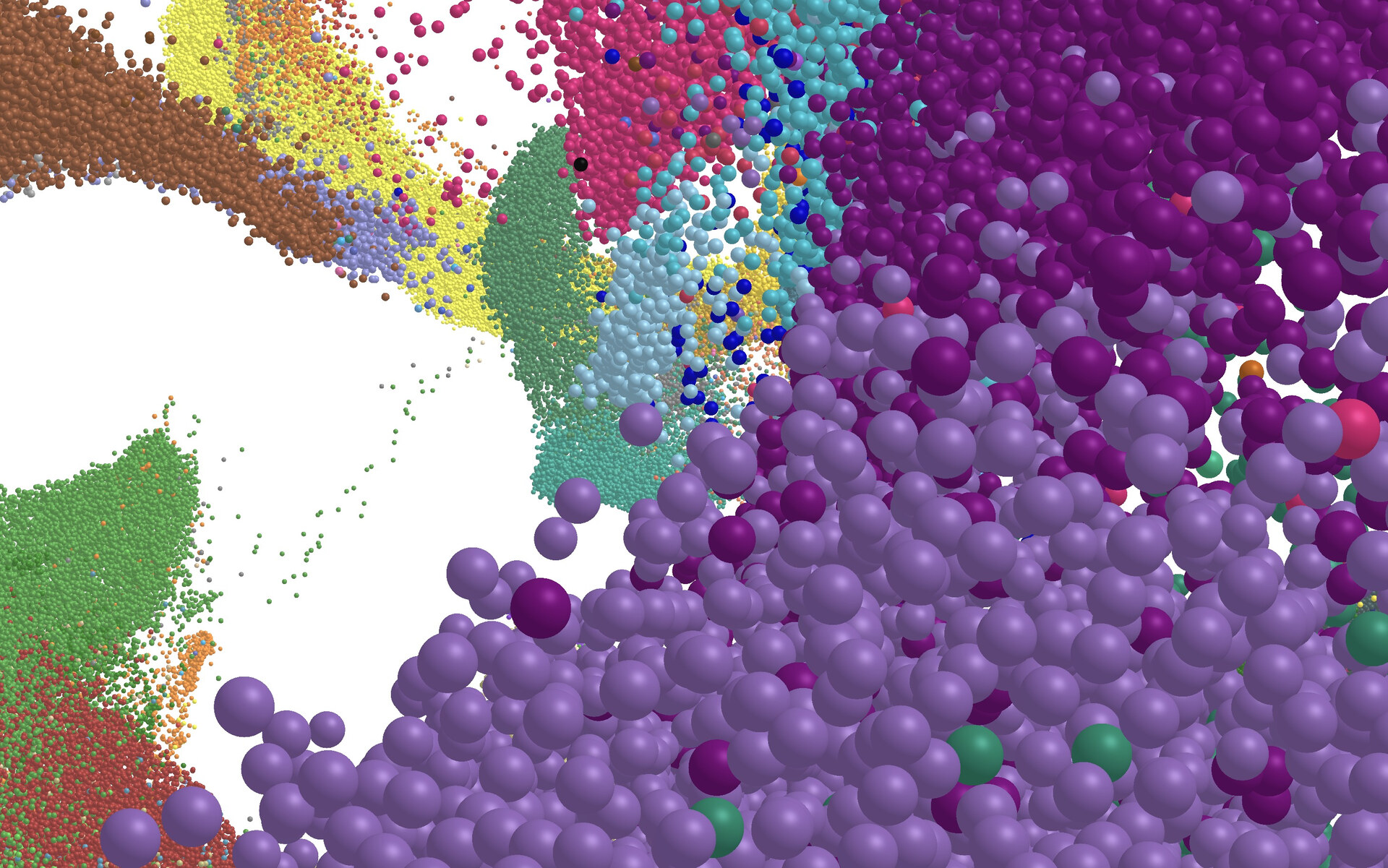
The Suo atlas makes Cellucid’s scale tangible: hundreds of thousands of cells remain individually visible as you move from tissue-wide structure into a close-up view.#
Start with the question in front of you#
You do not need to learn the whole application before doing useful work. Pick the route that matches today’s question.
Color by a categorical obs field, search for marker genes, filter noise, and
highlight a population without losing the surrounding context.
Open the real Pancreas sample, compare its 1D, 2D, and 3D embeddings, and inspect the dimension-matched RNA-velocity overlay.
Build a small public catalog with stable dataset identities, test it locally, and share an exact URL that opens the intended dataset.
Embed Cellucid in Jupyter, inspect connection health, exchange selections and state with Python, and stop the local viewer cleanly.
Bring data in the way that fits the work#
What you have |
Best first path |
Why |
|---|---|---|
A prepared Cellucid folder |
Fast local exploration with no separate server |
|
A small H5AD or portable Zarr ZIP |
One direct local selection |
|
A large H5AD, Zarr directory, or prepared catalog |
Exact server-side validation and on-demand browser gene requests |
|
An in-memory |
A tight analysis-to-visualization loop |
|
A public collection of prepared datasets |
No running server; exact catalog and share links |
The complete data-loading map explains the memory, network, privacy, and reproducibility tradeoffs before you commit to a path.
Learn at your own depth#
Warm, task-focused guides for navigation, coloring, filtering, highlighting, analysis, overlays, multiview, sessions, figures, accessibility, and troubleshooting.
Exact preparation, server, Jupyter, hooks, session, performance, and API contracts—from a first notebook to a reproducible deployment.
Prepare the same browser-ready format from matrices, Seurat, or SingleCellExperiment, then validate and share it through the same viewer.
One ecosystem, clear handoffs#
cellucid is the web application.
cellucid-python prepares, serves, and embeds data.
cellucid-r prepares the same export contract from R.
cellucid-datasets hosts the public sample catalog, including the standard Pancreas dataset.
cellucid-demo-custom-datasets is a tiny, inspectable model for your own public catalog.
cellucid-annotation provides the repository contract for community annotation.
Install the Python tools with pip install cellucid. For R installation and
supported inputs, begin with the R guide.