
Export / Data Preparation (prepare)#
This page documents prepare(), which writes an exported dataset directory that can be:
opened via the web app (file picker),
served with
cellucid serve ./export,embedded in notebooks with
show().
If you want the long-form, user-guide style walkthroughs, see:
Data Preparation API (prepare/export) — The Big One (data prep API, shapes, edge cases)
Audience + prerequisites#
Audience
Wet lab / beginner: use the copy/paste example and the troubleshooting section.
Computational: read the parameter and performance sections before exporting large datasets.
Developer: read the output format + determinism notes if you need stable exports for papers/CI.
Prerequisites
pip install cellucidTypically:
numpy,pandas,scipyIf sourcing from AnnData: you’ll usually have
adata.obsm,adata.obs,adata.var,adata.X
Fast path (copy/paste)#
from cellucid import prepare

X_umap_2d = adata.obsm["X_umap_2d"]

prepare(
    latent_space=adata.obsm["X_pca"],
    obs=adata.obs,
    var=adata.var,
    gene_expression=adata.X,
    connectivities=adata.obsp.get("connectivities"),

    X_umap_2d=X_umap_2d,

    out_dir="./my_export",
    dataset_name="My study",
    dataset_id="my-study-v1",
    obs_categorical_dtype="uint16",
    compression=6,
    var_quantization=8,
    obs_continuous_quantization=8,
)
created_at is optional. Its default records the current UTC export time. A
canonical dataset builder that must reproduce the complete directory
byte-for-byte should instead pass its fixed provenance timestamp in exact UTC
seconds format, for example created_at="2026-07-26T12:34:56Z".
Practical path (what to decide before you export)#
1) Do you want reproducibility or convenience?#
Convenience: use
show_anndata()/serve_anndata()(no export).Reproducibility + shareability: use
prepare()once, then reuse the folder.
2) Choose compression and quantization#
These trade size vs speed vs fidelity:
compression=6is a good default for gzip.var_quantization=8is usually enough for coloring by gene expression.obs_continuous_quantization=8is usually enough for QC metrics and scores.
If you need exact values preserved:
set quantization options to
None(writes float32).
3) Decide which obs/genes you will ship#
obs_keys=Noneexports allobscolumns. For very wideobs, consider selecting a subset.gene_identifiers=Noneexports all genes. For hugen_genes, consider a curated list.
4) Vector fields (velocity / drift overlays)#
Vector fields are optional, but powerful:
They are per-cell displacement vectors in embedding space, not physical trajectories or absolute positions.
Naming convention:
<field>_umap_<dim>d.
See Vector fields (velocity / drift overlays) for helper functions and naming conventions.
Interface reference#
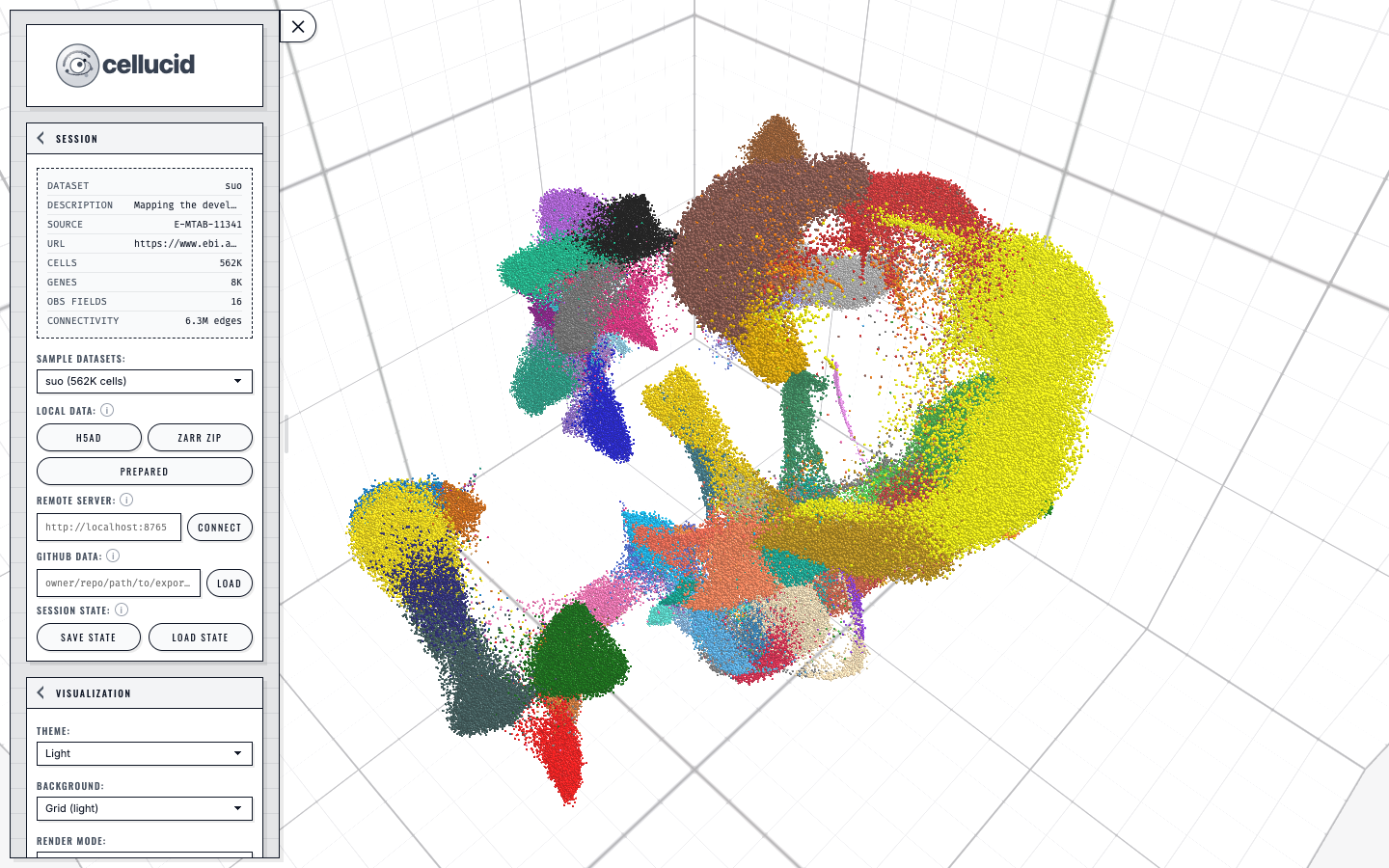
A loaded dataset in Cellucid: the sidebar controls the active view while the categorical legend maps directly to the colored points.#
Output directory layout (high-level)#
An exported dataset directory typically contains:
my_export/
├── dataset_identity.json
├── obs_manifest.json
├── var_manifest.json                 # optional (gene expression)
├── connectivity_manifest.json        # optional (KNN edges)
├── points_1d.bin.gz                  # optional
├── points_2d.bin.gz                  # optional
├── points_3d.bin.gz                  # optional
├── obs/                              # obs field binaries
├── var/                              # gene expression binaries
├── connectivity/                     # KNN edge binaries
└── vectors/                          # optional (vector field binaries)
Notes:
You must provide at least one of
points_1d/2d/3d.
API reference#
- cellucid.prepare(latent_space=None, obs=None, var=None, gene_expression=None, var_gene_id_column=None, gene_identifiers=None, connectivities=None, out_dir=PosixPath('/home/docs/checkouts/readthedocs.org/user_builds/cellucid/checkouts/latest/docs/exports'), obs_keys=None, centroid_outlier_quantile=0.95, centroid_min_points=10, force=False, var_quantization=None, obs_continuous_quantization=None, compression=None, *, obs_categorical_dtype, dataset_name, dataset_id, created_at=None, dataset_description=None, source_name=None, source_url=None, source_citation=None, X_umap_1d=None, X_umap_2d=None, X_umap_3d=None, vector_fields=None, vector_field_default=None)[source]#
Build and atomically publish one complete canonical Cellucid export generation.
created_atdefaults to the current UTC time. Reproducible builders can pass an exactYYYY-MM-DDTHH:MM:SSZUTC timestamp; it is validated and preserved byte-for-byte indataset_identity.json.- Return type:
- Parameters:
latent_space (ndarray | spmatrix | None)
obs (DataFrame | None)
var (DataFrame | None)
gene_expression (ndarray | spmatrix | None)
var_gene_id_column (str | None)
connectivities (ndarray | spmatrix | None)
centroid_outlier_quantile (float)
centroid_min_points (int)
force (bool)
var_quantization (int | None)
obs_continuous_quantization (int | None)
compression (int | None)
obs_categorical_dtype (Literal['uint8', 'uint16'])
dataset_name (str)
dataset_id (str)
created_at (str | None)
dataset_description (str | None)
source_name (str | None)
source_url (str | None)
source_citation (str | None)
X_umap_1d (ndarray | None)
X_umap_2d (ndarray | None)
X_umap_3d (ndarray | None)
vector_field_default (str | None)
Edge cases (do not skip)#
Missing embeddings#
If none of
X_umap_1d,X_umap_2d,X_umap_3dare provided, export fails.Only
X_umap_1d,X_umap_2d, andX_umap_3dare accepted keyword names.
Shape mismatches#
All inputs must agree on
n_cells(rows).gene_expressionmust be(n_cells, n_genes)andvarmust describe those genes.
Required inputs (common surprises)#
latent_spaceis required and must be supplied explicitly.obsis required and must be aligned to the same cell order as embeddings.If you provide
gene_expression, you must also providevar(to name/describe genes).
Existing export directories#
A non-empty target directory raises
FileExistsErrorwhenforce=False.force=Truepublishes one complete replacement generation.
Vector field validation#
vector_fieldsmust be a dict of arrays (or sparse matrices).Each vector field must be 1D or 2D and have 1/2/3 components (for 1D/2D/3D overlays).
Keys must match
<field>_umap_1d,<field>_umap_2d, or<field>_umap_3d, and the matching embedding dimension must exist.
NaN/Inf and constant-value fields#
Scientific arrays must contain real finite values representable as
float32; invalid values reject before publication.Constant continuous fields are valid without quantization. Quantization rejects a constant field because the current compact contract requires
minValue < maxValue.
Very large datasets#
Export size scales with:
number of cells × number of exported embeddings
number of obs fields
number of genes included
For huge datasets, consider:
fewer genes,
quantization,
compression,
serving from a fast filesystem.
Troubleshooting (symptom → diagnosis → fix)#
Symptom: “At least one dimensional embedding must be provided”#
Fix:
Provide one of
X_umap_1d,X_umap_2d,X_umap_3d.
Symptom: “All embeddings must have the same number of cells”#
Fix:
Ensure every embedding array has exactly the same number of rows (cell order must match).
Symptom: “obs has N rows, but embeddings have M cells”#
Fix:
Ensure
obsrow order corresponds to the embedding row order (and gene expression if present).
Symptom: “Export folder is huge”#
Fix:
Enable quantization (
var_quantization,obs_continuous_quantization).Enable gzip (
compression).Export fewer genes (
gene_identifiers=) and/or fewer obs columns (obs_keys=).
Symptom: “latent_space is required for outlier quantile calculation”#
Fix:
Provide
latent_space=...with shape(n_cells, n_latent_dims).Common choices:
adata.obsm["X_pca"]adata.obsm["X_scvi"]
Symptom: “var is required if gene_expression is provided”#
Fix:
Pass
var=adata.varwhenever you passgene_expression=adata.X.
Symptom: an unsupported embedding keyword is rejected#
Fix:
Pass only
X_umap_1d,X_umap_2d, orX_umap_3d.
Symptom: “non-empty export directory”#
What’s happening:
prepare(...)refuses to mix a new generation with existing artifacts.
Fix:
If you want one complete replacement, call
prepare(..., force=True).If you want a clean export, write to a new
out_dir.
Symptom: “Vector field ‘…’ must have 1/2/3 components”#
Fix:
Ensure each vector field array is shaped
(n_cells, dim)withdim ∈ {1,2,3}(or 1D arrays for 1D).Ensure the vector field’s
n_cellsmatches the embeddingn_cells.
Symptom: “Export is extremely slow”#
Likely causes:
You are exporting many genes (large
n_cells × n_genes).Compression level is very high.
Fix:
Export fewer genes (
gene_identifiers=) or omit gene expression for a metadata-only export.Use quantization (
var_quantization=8) and moderate compression (compression=6).
See also#
Server (browser tab + local HTTP server) for serving exports (local + SSH tunnel)
Jupyter (notebook embedding + hooks) for embedding exports in notebooks
Output format specification (exports directory) for a deeper format spec (user guide section)