
Metadata and provenance#
Audience: computational users + anyone preparing manuscripts (reproducibility)
Time: 10–20 minutes
What you’ll learn:
What provenance/metadata is attached to exported figures (if supported)
What information you should record even if it is not embedded automatically
A template “methods” sentence/block for papers
Prerequisites:
A dataset loaded
You can export at least one figure (see Export UI walkthrough)
What “provenance” means for a Cellucid figure#
Provenance is the answer to:
“What exactly am I looking at, and how could I recreate it?”
For a Cellucid figure, that usually means recording:
Data identity
dataset name and dataset id (or an exported folder version tag)
how the dataset was loaded (local folder, server, URL, notebook)
ideally a version/commit hash for the dataset export, if you maintain one
View identity
which view was exported (live view vs a snapshot view, or multiview grid)
the dimension (1D/2D/3D)
camera pose/projection (implicitly captured by the export, but you still want the saved state)
Scientific state
active color-by field (and whether it is categorical vs continuous)
legend mapping (category colors or colormap)
filters/visibility (what was hidden at export time)
highlights/selection emphasis (if used)
Export settings
plot size (W×H)
format (SVG vs PNG)
DPI (for PNG)
explicit SVG point strategy (Full vector, Optimized vector, or Hybrid)
include axes/legend/title/background
frame export crop rectangle (if used)
Tip
If you saved a session bundle right before exporting, you already captured most of the view/scientific state. The remaining missing piece is export settings (which are not stored in sessions).
What metadata is embedded into exports (must be explicit)#
Cellucid exports embed metadata by default (there is no “metadata off” toggle in the current UI).
PNG metadata (UTF-8 iTXt chunks)#
PNG exports include standard uncompressed iTXt fields such as:
Software:Cellucid (cellucid.com)Website:https://cellucid.comCreation Time: ISO timestampDatasetandDataset ID(when known)Color Field(field key)Source File(may be a URL or a local path, depending on how the dataset was loaded)Description(human-readable summary)Comment: a compact JSON blob that includes structured provenance:dataset (name/id/source URLs/user path/citation if present)
view (id/label)
field (key/kind)
filters summary
export settings (format/size/DPI/strategy/legend/axes/background/crop)
SVG metadata (RDF / Dublin Core + Cellucid JSON)#
SVG exports include a <metadata> block with:
Dublin Core fields like creator/publisher/date/source/description
Cellucid-specific tags including:
the active color field
the source file (URL or local path)
a JSON provenance blob similar to the PNG
Comment
Filenames (also part of provenance)#
Exports are named conservatively:
<dataset>_<color-field>_<view>_<timestamp>.svg<dataset>_<color-field>_<view>_dpi300_<timestamp>.png(when exporting multiple DPIs)<dataset>_<color-field>_<view>_batch_<timestamp>.zip(multi-file export)
This makes it easier to tell “what is this file?” even without opening it.
A batch ZIP adds no alternate scientific representation: each entry is the same native artifact, with its own embedded metadata, that the corresponding single-file renderer produces.
Important
The embedded metadata is useful, but it does not replace version control. For long-term reproducibility, also record:
the Cellucid app version/commit (if you have it), and
the dataset export version you used.
Recommended “methods text” template (for papers)#
Use this as a starting point and adapt to your norms/journal requirements:
“Figures were generated in Cellucid (cellucid.com; version/commit: ) from dataset ___ (dataset id/version: ). The exported view used color-by field ___ with filters ___ applied. The interactive state (camera, fields, and filters) was saved as a session bundle (). Figures were exported at plot size × using ___ format ( DPI for PNG) and ___ strategy (full/optimized/hybrid).”
If you used point reduction (optimized vector), add:
“For SVG export, points were reduced using density-preserving sampling to keep approximately ___ points for visualization.”
If you used a crop (Frame export), add:
“Figure framing used an export crop without changing the interactive camera view.”
How this relates to sessions and sharing#
Is a session bundle sufficient?#
A session bundle is the best way to preserve the interactive state (views, cameras, filters, fields, highlights). However:
figure export UI settings are not stored in sessions,
so you still need to record export settings (or recover them from embedded metadata in the exported file).
What if the dataset export changes?#
If the dataset export changes between exports (common in iterative pipelines):
field keys can change,
category ordering can change,
legends can change,
filters can target different distributions,
and a “re-export” may not match.
For manuscript figures, treat the dataset export as immutable once you start final export production.
How to package for collaboration#
To make a figure reproducible for a collaborator, share:
the dataset export folder (or a stable URL), plus
the session bundle, plus
the exported artifact(s) (SVG/PNG), plus
(optional but recommended) a short README describing export settings and any post-processing.
Important
If you need to share figures publicly, inspect embedded metadata first. It may contain local file paths or private URLs depending on your loading workflow.
Related pages:
Interface reference#
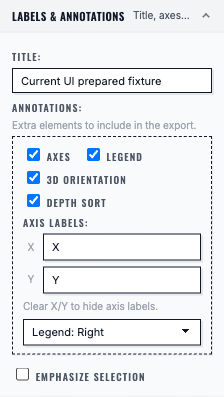
Labels and Annotations makes title, axis, legend, and annotation choices explicit.#
Next steps#
Troubleshooting (figure export) (missing metadata, unexpected outputs)
Edge cases (datasets/legends that stress the export pipeline)